Acquainted with Grief

a man of sorrows, and acquainted with grief.”
Isaiah 53:3 ESV

For the past few days my thoughts have often been with the many worldwide who have suddenly come into grief. Actually, there is ample reason to dwell on this daily due to ravages of illness, starvation, wars, assaults, abuse, depression, oppression, etc. Yet with the COVID-19 numbers confronting me everywhere I look, the grief that others are facing often comes to mind.

I have been acquainted with grief.

In 1982, grief abruptly intruded my life with the sudden death of my 57-year-old father-in-law. Since then I’ve been impacted countless times by the grief of intimate family and friends or moved by the grieving of casual acquaintances and, more surprisingly, even by those I don’t know at all.

For decades I have realized that grief affects each person uniquely. We cannot tell someone HOW to grieve. We CAN, however, give them space and encouragement to grieve – in whatever way they need. And the forms in which grief expresses itself are MANY, far too many to list here. Those who assist with grief, professional or personal, have developed a compassionate discernment, an acknowledgement, and often a permission, verbal or silent, for the grieving one to proceed when the need surfaces.

Then a few months ago, I came upon this phrase – “acquainted with grief“ – right after a poignant discussion of our family’s four post-stroke years with Dale. For the first time, I sensed that grief has made me more like Christ. Wow…a purpose for the pain, clarified in one Scriptural phrase. Significant for me. I desire to follow hard after God, a term not often used yet pregnant with meaning: when the following, the pursuit, is itself difficult but definitely worth the travail. And He does not leave us alone as we pursue Him, but graces us with help – His Presence, the example of His Son, and the guidance of Holy Spirit. Thus we are able to continue following Him even in the hard times…seemingly impossible when alone or feeling alone, but possible WITH Him – that His plan, His will, be done on earth as it is in Heaven.

I say YES to following hard after God, even though I become more and more acquainted with grief. It serves well to develop in me a depth of compassion and insight into pain and its purpose, causing me to focus once again on the eternal. Hallelujah! We are eternal beings and yet so easily caught up in the physical realm, needing promptings to realign us with eternal perspective. So I rest in grief, rest in God, and find that joy fills my being from the inside out as His rivers of living water pour forth and bring life in the midst of sorrow.

Father thank you for Your plan and for Your guidance in following Christ, leaving us an example, so that we might follow in His steps. Help us to keep our eyes on the eternal, our spirit, the only part of us that will last forever.
(I Peter 2:21 ESV)

Tenth Avenue North “Hold My Heart
https://youtu.be/qEz2PsLJ-RI

Ponder

“Mary treasured up all these things and pondered them in her heart.”
Luke 2:19 NIV

” Pondered them in her heart.” Not something we hear very often, yet right now, as our society goes through a “stay at home” time, many of us can take time to ponder, contemplate, mull things over. Upon hearing the shepherds’ report of what the angels said, the mother of Jesus took a moment aside; the past nine months had been cause for many overwhelming feelings! Many times in the busyness of life, I’ve felt God nudge me to take a moment, to slow down. As I practice this I find:
– I can quiet myself and put the “noise” aside
– my thinking becomes clearer
– more options surface for consideration
– I am more conscious of receiving His peace
– direction becomes more evident

Personally, I still associate the term ponder with with a friend from years ago who used that word regularly in our discussions. His familiar usage of that word consequently caused me to pause and think more carefully. I am SO grateful for that lesson! It is now my practice whenever I begin to feel anxiety, fear or a sense of overwhelming coming at me to step away to ponder, usually by myself (even only for a few moments and even in a bathroom). And now, I encourage you to ponder – contemplate, consider – especially before making important decisions. Every decision, every step determines the direction you take and is worth taking an extra moment of conscious thought.

Oh, Father, as feelings and cares of life try to overwhelm me, help me to cast me cares on You because You care for me.
(I Peter 5:7)

Chuck Girard “Slow Down”
https://www.youtube.com/watch?v=XUtXIho15mE

Zoey’s Extraordinary Playlist

“For I am not seeking my own good but the good of the many…” -I Corinthians 10:33 NIV

When I first considered writing about caregiving, the TV pilot for “Zoey’s Extraordinary Playlist” had not even aired. In fact, I didn’t hear about it until the first of March this year when on a text message, my sisters referred to the show with one of them saying “we didn’t think it would have been good at all for Donna”. WHAT!!! I was in on that text and immediately reacted, thinking “How can you say this isn’t good for me? I need to check this out”. Of course, knowing full well my sisters were concerned about my well-being, I spoke with them and found out they thought it could be too emotional for me.

Fast forward: I immediately watched the first 3 episodes the first chance I had! Poignant – yes; a few tearful times – yes; things with which I disagree – yes; a bit hard to watch the portrayal of Zoey’s beloved dad who is slowly dying from a neurological disease – yes; worth the emotional ups-and-downs – YES! First of all let me say I LOVE MUSIC and this show is filled with music and dance – through a very unique, innovative presentation. That I love! This show is definitely written for an audience younger than I am, however, it speaks directly to the generation/s who have parents who are caregivers or who are receiving help from caregivers. The show’s family relationships are rich and lovingly sensitive to the dad’s situation, and the insights the siblings gain about mom as caregiver are a much-needed dimension in today’s society. That is my reason for continuing to watch this show and why I will proffer that it is worth a try for any adult. Caregivers’ loads and needs are highly misunderstood and therefore often neglected. I am both amazed and grateful that Hollywood has taken this on as a topic to address publicly. Caregivers are not the focus of the show, though, and after the first 3 episodes, played a rather small part, but that could readily vary with any future episode. That being said, anyone who watches the show will at least have exposure to some reality of caregiving.

I am most thankful that my children had a grasp of the needs of caregivers as I found myself in that role. Our family and extended family have all taken care of their aging or ill parents, providing an example and an opportunity to naturally observe and learn about caregiving – the good, the bad, and the ugly. As I participated in the intermittent care of my own parents and mother-in-law, circumspect family conversations that later included my grandkids gave voice to concerns and possible ways to assist caregivers, giving them a measure of respite. Communication and careful observation are key in learning about and then maintaining caregiver health – mental, physical, emotional, and social. In that light, anyone watching “Zoey’s Extraordinary Playlist” will have opportunity to gain from the observation of both the care and the caregiver as well as the ensuing communication.

Lord, you continue to amaze me at the resources You provide, even from unlikely sources. I pray blessings on those who write and produce and finance ” Zoey’s Extraordinary Playlist”, for Your guidance as they go forward, and that You draw forth the audience who needs to learn about the needs of caregivers.

Chris Tomlin “Good, Good Father”
https://youtu.be/OfJrxvVnmkE

Feeling confined?

“The LORD your God in your midst, The Mighty One, will save; He will rejoice over you with gladness, He will quiet you with His love, He will rejoice over you with singing” -Zephaniah 3:17 NKJV

Everywhere in the news for the past week we’ve heard about self-quarantine and social/physical distancing. I was away camping for the past week while SO much changed so quickly. Amazing! Yet we had no problem in our camp life, except for hand sanitizer😏. We in the U.S. are not used to hearing directives…and being socially confined in any way is NOT something to which our society as a whole is accustomed. We value our independence in our freedom to make daily decisions of where to go and what to do. Occasionally, during blizzards or hurricanes, we are forced by nature to “stay put”, but now with widespread contagion, drastic confinement in other countries, and our own numerous restrictions this week, we all have had to adjust, often in a matter of hours – whether by personal choice or not of our choosing.

As I write this blog re: caregiving, confinement and personal restriction are no longer that foreign to me and I realize I’ve actually become practiced in it. I’ve had my freedoms confined several times in my adult life, sometimes by choice – staying home with each of my newborns, a job change with much more alone time after teaching school for years – and sometimes not my choosing at all – short term illness, hurricanes, floods, and most recently the immediate need as a caregiver after Dale’s stroke. That 4-year season was by far the most life-changing, with lengthy hospital/rehab stays and becoming more housebound for the last two years. The amazing result was that each time I was more confined, my personal growth flourished! Consequently, I recognize it has value for me and for others.

Presently the national COVID-19 health situation is causing us to address health from a community and national perspective, unfamiliar territory to most of us. However, working for the common good is not a new phenomenon and much good can come out of taking a new perspective, one that is bigger than ourselves, not self-centered. I am grateful for the times I’ve had to look at the bigger picture, not just my personal preferences.

Most recently, five years ago when my husband Dale had his massive stroke, I chose to stay with him nearly every waking hour – in ICU, hospitalization, and early rehab, becoming his advocate as well as his eyes and ears. Later living with him 10-12 hours a day in a lockdown neuro rehab facility along with 5 other brain-injured individuals and up to 6 medical attendants, I was confined in the same way he was and often left alone as he napped or was at therapy. At night I drove 30 minutes to stay with Dale’s sister and brother-in-law, adjusting to my home away from home. Definitely a daily routine out of my comfort zone! And this went on for over 3 months – NOT my preference but definitely my decision for the best interests of my husband. And you know what? MUCH good came out of that time – not just the improvement in Dale’s health, but the opportunity to encourage and love other patients who needed “family” when theirs were far away, to receive love and care myself from relatives, to be an advocate for Dale on a daily basis and an asset to the medical team by my presence and assistance. I still marvel at the GOOD that came out of that unlikely and even awkward situation, including developing new compassion in me and providing me with insights that still serve me almost daily 5 years later.

As you’re considering what to do in confining situations, realize we can still engage in wise, careful interaction with those near us and implement the timely use of social media or technology to our benefit for social interaction…even if it’s not our normal practice. I’m not giving you a list of “things to do”; an abundance of suggestions are already being brought forth as people share ideas. Do realize, however, there is no better time to develop your relationship with God, and we have Biblical examples in Paul and John for doing so in times of isolation, as well as a host of others who have been exiled, imprisoned, quarantined, Madame Guyon providing a more recent account.

The main thrust of my encouragement is that you take a stand against loneliness and self-pity, actually anything negative. I will even go as far as to say that loneliness is a tool of the enemy of our soul meant to discourage us. Those many hours I spent alone by Dale’s side often required me to be on guard – against isolation by reaching out, against depression by counting my many blessings, and against self-pity by realizing that former trials I’d faced had prepared me for such a time as this. Every time I reached out to others with a kind word, a smile, or a caring gesture, the reality that I was not alone became more evident. The Truth is that we are never alone – we can be certain that God is with us (Deuteronomy 31:8 NKJV) and that we are often joined in the spirit with others.

Remember, we often need support and encouragement of others. Ask for help even just to take the next step. If you need to reach out to me, please do so in your comments below. We have many vehicles by which we can help one another…and it usually takes far less time and effort to make a positive difference than we initially expect. Just reach out…

Thank you, Father, that we can be filled with the Holy Spirit, encouraging one another and giving thanks always, trusting that nothing we are facing comes as a surprise to You and You are faithful to see us through it. ( Ephesians 5:17-21; Philippians 4:6-8 NKJV)

Kim Hill “Slip Away”
https://youtu.be/enxca57LiVU

“Nagatives”

“ I lift my eyes to the mountains. Where does my help come from? My help comes from the Lord, Maker of heaven and earth” -PSALM 121:1-2 NIV

In the midst of “normal“ living, thoughts we don’t want to have will intrude upon our minds, often at the most opportune times. Melancholy, fear, disappointment, anger, loneliness, sorrow – negative thoughts – which, left unchecked, would bring us down, mentally and emotionally at first, and physically if we allow them to rule. Often coming in a barrage, these “nagatives” tend to worm their way into our consciousness, trying to grab us by their repetition.

Once you recognize this attack on your mind, it is wise to start your own counterattack with truth – simple and forthright statements that you can repeat at will. “Be still and know that I am God” (Ps. 42:6) gives us direction to quiet ourselves and recognize Who really is in control. Your situation- or that of world events- is NO SURPRISE to God. And He will give you direction if you will only quiet yourself enough to listen. That takes PRACTICE. PRACTICE. PRACTICE. How do you conquer the “mountain” in front of you? One step at a time. Practice listening for the details of that next step. I can’t help thinking that if I were blind, or in the darkness of night in a strange place, that I would listen VERY carefully to the one guiding me through that darkness. We need to practice listening for God’s direction, no matter how or through whom He sends it.

During my study of the brain after Dale’s stroke, I recalled a short and simple video by Dr. Phil Parker that we both had seen on NEUROPLASTICITY, the ability for the brain to change itself. This truth was key in helping Dale to develop new neural pathways, yet we had first learned of it in regard to changing our personal habits. I’ve included a link to this 90-second video below and suggest you watch it. You will be encouraged that you can change your thinking habits and overcome the “nagatives” that you face.

https://youtu.be/tJ93qXXYRpU

Steps to changing your thinking habits:

  • Recognize nagatives.
  • Quiet yourself.
  • Speak aloud simple truths.
  • Listen for the next step.
  • Take that next step.
  • Practice, practice, practice

Get help if needed. You are not alone. Oftentimes we need the support and encouragement of others just to take that next step. Know who’s on your team and ask for help.

Thank you, Father for Your plans for us and for the guidance of Your Holy Spirit (Jeremiah 29:11, John 14:26 ESV)

Casting Crowns “Voice of Truth”
https://youtu.be/enxca57LiVU

Forty Things

Important reference points for all who need care

In 2014 when my husband Dale had a massive stroke event, one of the first resources brought to my attention was Jill Bolte Taylor’s autobiographical book “My Stroke of Insight”. As she shared from her personal journey of recovery, the individuals she encountered often fell short of actually meeting her needs and many who cared simply had no knowledge of who do and how best to help her. The following list is one I’ve shared countless times with family, friends, and caregivers as reminders from which we all can benefit. Thank you, Jill, for this thoughtful compilation.

Forty Things I Needed the Most

  1. I am not stupid, I am wounded. Please respect me.
  2. Come close, speak slowly, and enunciate clearly.
  3. Repeat yourself – assume I know nothing and start from the beginning, over and over.
  4. Be as patient with me the 20th time you teach me something, as you were the first.
  5. Approach me with an open heart and slow your energy down. Take your time.
  6. Be aware of what your body language and facial expressions are communicating to me.
  7. Make eye contact with me. I am in here – come find me. Encourage me.
  8. Please don’t raise your voice – I’m not deaf, I’m wounded.
  9. Touch me appropriately and connect with me.
  10. Honor the healing power of sleep.
  11. Protect my energy. No talk radio, TV, or nervous visitors! Keep visitation brief (five minutes).
  12. Stimulate my brain when I have any energy to learn something new, but know that a small amount may wear me out quickly.
  13. Use age-appropriate (toddler) educational toys and books to teach me.
  14. Introduce me to the world kinesthetically. Let me feel everything. (I am an infant again.)
  15. Teach me with monkey-see, monkey-do behavior.
  16. Trust that I am trying – just not with your skill level or on your schedule.
  17. Ask me multiple-choice questions. Avoid Yes/No questions.
  18. Ask me questions with specific answers. Allow me time to hunt for an answer.
  19. Do not assess my cognitive ability by how fast I can think.
  20. Handle me gently, as you would handle a newborn.
  21. Speak to me directly, not about me to others.
  22. Cheer me on. Expect me to recover completely, even if it takes twenty years!
  23. Trust that my brain can always continue to learn.
  24. Break all actions down into smaller steps of action.
  25. Look for what obstacles prevent me from succeeding on a task.
  26. Clarify for me what the next level or step is so I know what I am working toward.
  27. Remember that I have to be proficient at one level of function before I can move on to the next level.
  28. Celebrate all of my little successes. They inspire me.
  29. Please don’t finish my sentences for me or fill in words I can’t find. I need to work my brain.
  30. If I can’t find an old file, make it a point to create a new one.
  31. I may want you to think I understand more than I really do.
  32. Focus on what I can do rather than bemoan what I cannot do.
  33. Introduce me to my old life. Don’t assume that because I cannot play like I used to play that I won’t continue to enjoy music or an instrument, etc.
  34. Remember that in the absence of some functions, I have gained other abilities.
  35. Keep me familiar with my family, friends, and loving support. Build a collage wall of cards and photos that I can see. Label them so I can review them.
  36. Call in the troops! Create a healing team for me. Send word out to everyone so they can send me love. Keep them abreast of my condition and ask them to do specific things to support me – like visualize me being able to swallow with ease or rocking my body up into a sitting position.
  37. Love me for who I am today. Don’t hold me to being the person I was before. I have a different brain now.
  38. Be protective of me but do not stand in the way of my progress.
  39. Show me old video footage of me doing things to remind me about how I spoke, walked, and gestured.
  40. Remember that my medications probably make me feel tired, as well as mask my ability to know what it feels like to be me.

Medical Info Sheet

This is a time-saver!

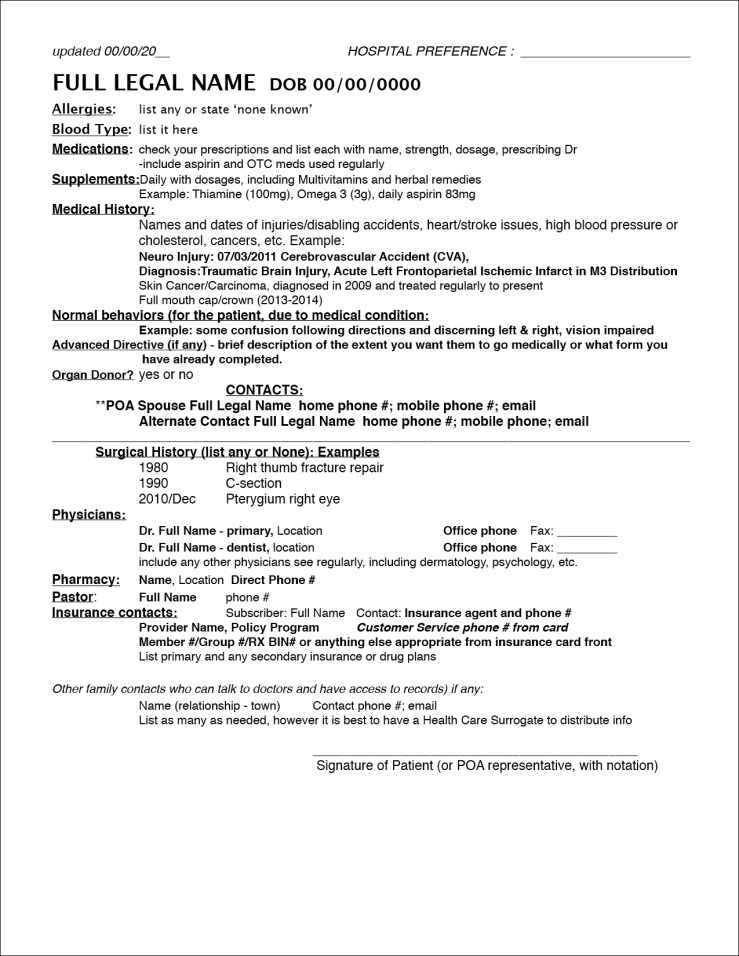
Years ago when accompanying my mother to doctors’ appointments as her health advocate, I realized the inefficiency – and irritation – of having to repeatedly fill out all her medical info. At that point, using the customary requested info form as a starting point, I developed a template with all pertinent info that could be saved, changed and printed or sent digitally. Both of us used this from that time forward, and after Dale’s stroke, we had it evaluated by a nurse, an EMT and an EMT trainer.

Pictured below is the Medical Info Template I created. Under “Recommended Sites” in the sidebar on the right of the page, there is a link for Medical Info Template that you can download for yourself and others. As you consider adapting it for yourself, be sure to consider the following:

  • Date of most recent list update – REMEMBER TO CHANGE THIS AS YOU UPDATE!
  • Hospital preference/blood type are priorities for EMTs
  • Do NOT include your Social Security # or Medicare # (security reasons)
  • Medicines must state name of prescription, dosage and frequency
  • Family contacts should include everyone that can receive personal health info; health care surrogate is preferable to keep info distribution simplified
  • Print on colored paper so for easy ID for medical staff (the “blue sheet”)
  • SIGN ALL COPIES every time you print new ones – signature validates all info (note “POA” if person with Power of Attorney is signing & keep copy of legal POA document on hand)
  • Place a copy of each household member’s Med Info on your refrigerator and in glove box of car
  • Take a copy with you when you travel (along with legal documents – POA, living will, DNR)
  • When filling out forms at medical offices, you simply write “see Medical Info form” for anything lengthy – meds, surgeries/hospitalizations, doctors, etc.- and hand the Med Info form to the office. I usually asked them to keep my copy so it could be referenced by paper color.
  • If hospitalized, hand color copy to ER staff as well as nurses’ station if admitted

Intensive Care (ICU)

Beloved, let us love one another -I John 4:7 NIV

Having just been made aware of someone in ICU due to several strokes, I wrote them my offer of experience and help. In doing so, it was evident that others would benefit from this information. Glad to share:) I remember those first weeks of learning new medical terminology and how much there was to remember. Most of all right now a patient advocate – spouse, family member, friend – is needed to be the extra set of eyes/ears. Doctors and nurses and staff will come and go, but the advocate will remain the constant, the one who know the patient best, can see the overview as people and medications and therapies and needs change, and speak up on behalf of the patient.

FOR YOUR IMMEDIATE CONSIDERATION:

-Keep your eyes on the Lord; the situation you in which you find yourself is no surprise to Him
    –Slow down and keep things simple – waiting on God for the next step and accepting His peace as you do
    -Keep up with your support system – family, church, friends – so they know how to help/pray. I suggest Caring Bridge (Recommended Sites at right) – the best and simplest way to share info to anyone you want without having to talk too much and field calls/questions.
    -That being said, both patient and advocate need REST – both to survive this and to heal/recover.  The best info I received about rest is that 70% of our brain stimulation comes through the eyes – light and sight. If we COVER our eyes, we then only use 30% of our brain energy and get the best rest.  My husband Dale and I used to keep eye masks handy and put one on regularly, even for 5 minutes, for a “brain break”. Most helpful!
   –Receive help. Simple to state but often not so easy to do. When someone asks how they can help you, have a list ready: sit with patient for 20-30 so advocate can walk about, go outside for fresh air and sunshine(courtyard is wonderful), etc; bring dinner/coffee; do laundry; run errands. Just say YES. There is a time to give and a time to receive. It’s God way of ministering one to another.
    -Find ways to laugh – add humor, tell jokes, watch funny shows, cat videos are a favorite for many!
    -Remember the ministry of touch – hold hands, light massage, comforting pats, skin-to-skin is SO helpful.
    –Fresh air and sunshine for both of you when it is possible to go the the atrium or courtyard
    -Best food for brain healing is fresh food. For a simple, healthy and quick meal supplement, our favorite and healthiest shake, although not fresh food, available even at Publix is ORGAIN – even comes in chocolate! Prepackaged shakes and powder to make your own and mix with other things when you want.
    –Keep a notebook – don’t trust your memory. Write everything down: questions, lists, suggestions, to-do’s, medicines, doctor/staff names   – -Just be present – that’s the best gift, not to be alone in this.

Thank you, Father, for care and caregivers, medical staff and their knowledge, safe and clean hospitals and for Your healing Presence (I am with you always…Matthew 28:20 NIV)

SONG LINK:
Michael W. Smith “I Will Be Here for You”
https://youtu.be/bxGmsh1VuxA

A Time for Tears

Weeping. Crying. Sobbing. Wailing. Viable grief, mourning, sorrow; we are emotional beings…for our good. “a time to weep” -Ecclesiastes 3:3 ESV

Tears often make an appearance suddenly, unplanned…and often not preferred. We all cried as babies, but as we grew to adulthood, social stigmas were taught or learned, implying that crying — particularly at work or in public, or in men– is something to be avoided, ashamed of, or is a sign of weakness. Medical research proves the opposite: emotional tears have been found to eliminate stress hormones and other toxins from the body. Crying also stimulates the production of endorphins, our body’s natural pain killers and “feel-good” hormones, bringing physical and mental relief. Many years ago I learned to give free rein to tears for my own mental and physical health after experiencing chronic back pain. Through the medical truths presented in Dr. John Sarno’s book “Healing Back Pain”, I addressed issues that I had repressed for years. Tears came, I allowed them, and at that point found the release and relief that accompanied crying and positively affected my physical being.

As a caregiver, many situations provoke emotional tears: loss, sorrow, grief for your loved one, compassion, frustration, weariness, being overwhelmed, exhaustion, to name a few. You will also face times that you cannot give way to crying – in emergencies when things happen too quickly, when you need to make immediate decisions, or even when your crying would hamper the emotional well-being of your loved one or halt the progress of their therapy. However, when tears and emotions are repressed, you will find they will surface later in some way and often “out of the blue”. At those times, it is wise to give yourself a time to grieve, allowing the memories to surface and the tears to flow, developing the strength and self-awareness to cry. Doing so will aid in the process of resolving your sadness and grief as well as preventing depression.

If you personally still need permission to yield to tears, then consider that permission is granted – from your Creator, your Heavenly Father, as He created you. “You will know the truth, and the truth will set you free” -John 8:32 ESV. We are free to be all God created us to be, unashamed and without fear of anyone’s reactions, judgment or retribution. Truth states there is a time for everything under heaven (read Ecclesiastes 3:1-8) and Truth is that Jesus wept and He is our example (John 11:35). As we yield to God as Lord of our emotions, the very emotions He created in us, we can freely give rein to tears, knowing His Lordship will undergird us with peace and those tearful moments will be just that –moments, although at times they may seem never-ending – and they will serve His purpose in us and in others, even if we never know to what extent.

Thank you, Father, for tears – cleansing, healing, releasing our overflowing emotions, and that You know us inside and out. (Psalm 139:1-18 ESV)

SONG LINK:
Mandisa “Just Cry”
https://youtu.be/pxvnVa-dGT8

Count Your Blessings

“Give thanks in all circumstances; for this is God’s will for you in Christ Jesus” -I Thessalonians 5:18 NIV

When Christy was in college, she and I read Simple Abundance by Sarah Ban Breathnach. Although I knew to thank God and had a thankful heart, this book was key in developing in me a lifetime practice of thanking God and counting blessings at the start of each new day. Consequently, years later when we were blindsided by Dale’s stroke, it was natural for me to be grateful – for his life, quick medical response, air flight, my iPad, honest ER doctors, family arriving within hours, and so much more.

Excerpt of blessings listed in my Caring Bridge journal 10-20/21-14

  • visits from pastors and friends
  • brother-in-law’s research
  • our son David, a godly man and honorable son
  • Officer’ s kindness and consideration for our family
  • sister’s availability and, of course, love and good food
  • today’s technology that keeps family and info at our fingertips
  • those who’ve walked this walk sharing insight, hope and their stories
  • smiling, caring, knowledgeable medical staff
  • coffee
  • friend having Dale’s laundry done before I even got home
  • Christy’s volleyball team winning first round of districts

Whatever the situation, there are always things for which we can be thankful. Our hearts and lives benefit from thankfulness as it renews our minds, fills us with hope, and reminds us of just how very much we have. Since the truth is that none of us are guaranteed tomorrow, or even our next breath, let’s be thankful for the blessing of breath/oxygen. In my darkest, most helpless hours, I counted blessings of shoes on my feet, water, bathrooms, life itself…things we so easily take for granted, especially in the U.S. where we live amidst such abundance.

When I determined to journal, I started with a blank journal, each day listing 3 things for which I was thankful; after just a week I had a reminder of 21 blessings! We ARE blessed and it’s healthy to acknowledge it. I suggest you give it a try!

Oh, Father, You Who made us know the value of thankfulness; help me to cultivate gratitude in my daily life. (Psalm 100:4)

SONG LINK:
Julie Andrews “My Favorite Things”
https://youtu.be/bACiODIbf84