
Important reference points for all who need care
In 2014 when my husband Dale had a massive stroke event, one of the first resources brought to my attention was Jill Bolte Taylor’s autobiographical book “My Stroke of Insight”. As she shared from her personal journey of recovery, the individuals she encountered often fell short of actually meeting her needs and many who cared simply had no knowledge of who do and how best to help her. The following list is one I’ve shared countless times with family, friends, and caregivers as reminders from which we all can benefit. Thank you, Jill, for this thoughtful compilation.
Forty Things I Needed the Most
- I am not stupid, I am wounded. Please respect me.
- Come close, speak slowly, and enunciate clearly.
- Repeat yourself – assume I know nothing and start from the beginning, over and over.
- Be as patient with me the 20th time you teach me something, as you were the first.
- Approach me with an open heart and slow your energy down. Take your time.
- Be aware of what your body language and facial expressions are communicating to me.
- Make eye contact with me. I am in here – come find me. Encourage me.
- Please don’t raise your voice – I’m not deaf, I’m wounded.
- Touch me appropriately and connect with me.
- Honor the healing power of sleep.
- Protect my energy. No talk radio, TV, or nervous visitors! Keep visitation brief (five minutes).
- Stimulate my brain when I have any energy to learn something new, but know that a small amount may wear me out quickly.
- Use age-appropriate (toddler) educational toys and books to teach me.
- Introduce me to the world kinesthetically. Let me feel everything. (I am an infant again.)
- Teach me with monkey-see, monkey-do behavior.
- Trust that I am trying – just not with your skill level or on your schedule.
- Ask me multiple-choice questions. Avoid Yes/No questions.
- Ask me questions with specific answers. Allow me time to hunt for an answer.
- Do not assess my cognitive ability by how fast I can think.
- Handle me gently, as you would handle a newborn.
- Speak to me directly, not about me to others.
- Cheer me on. Expect me to recover completely, even if it takes twenty years!
- Trust that my brain can always continue to learn.
- Break all actions down into smaller steps of action.
- Look for what obstacles prevent me from succeeding on a task.
- Clarify for me what the next level or step is so I know what I am working toward.
- Remember that I have to be proficient at one level of function before I can move on to the next level.
- Celebrate all of my little successes. They inspire me.
- Please don’t finish my sentences for me or fill in words I can’t find. I need to work my brain.
- If I can’t find an old file, make it a point to create a new one.
- I may want you to think I understand more than I really do.
- Focus on what I can do rather than bemoan what I cannot do.
- Introduce me to my old life. Don’t assume that because I cannot play like I used to play that I won’t continue to enjoy music or an instrument, etc.
- Remember that in the absence of some functions, I have gained other abilities.
- Keep me familiar with my family, friends, and loving support. Build a collage wall of cards and photos that I can see. Label them so I can review them.
- Call in the troops! Create a healing team for me. Send word out to everyone so they can send me love. Keep them abreast of my condition and ask them to do specific things to support me – like visualize me being able to swallow with ease or rocking my body up into a sitting position.
- Love me for who I am today. Don’t hold me to being the person I was before. I have a different brain now.
- Be protective of me but do not stand in the way of my progress.
- Show me old video footage of me doing things to remind me about how I spoke, walked, and gestured.
- Remember that my medications probably make me feel tired, as well as mask my ability to know what it feels like to be me.
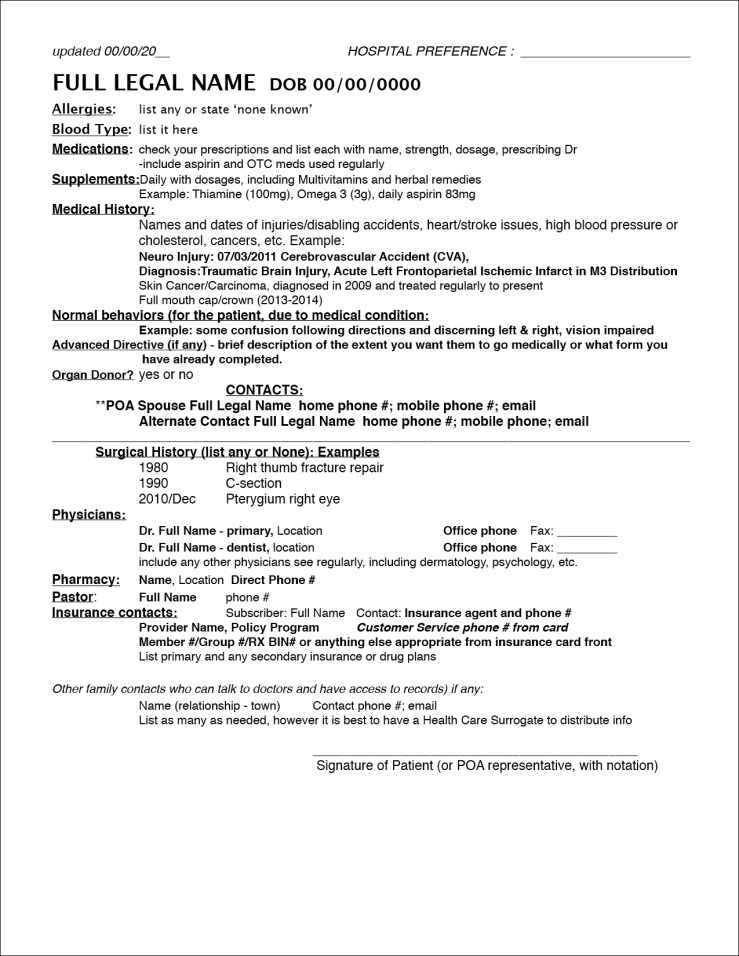
 For Those Who Care